
Philosophy & Leadership
- Home
- Philosophy

Courage & Resistance
Bhima Nayak believed that fear must never silence truth or justice. His courage was rooted in moral conviction, enabling him to stand firm against colonial oppression and defend his people’s dignity, rights, and freedom even in the face of overwhelming force.

Unity & Tribal Dignity
He guided his people with the principle that unity is strength. By fostering collective identity and self-respect among tribal communities, Bhima Nayak reinforced dignity, cultural pride, and shared responsibility as foundations of lasting resistance.
People-Centered Leadership
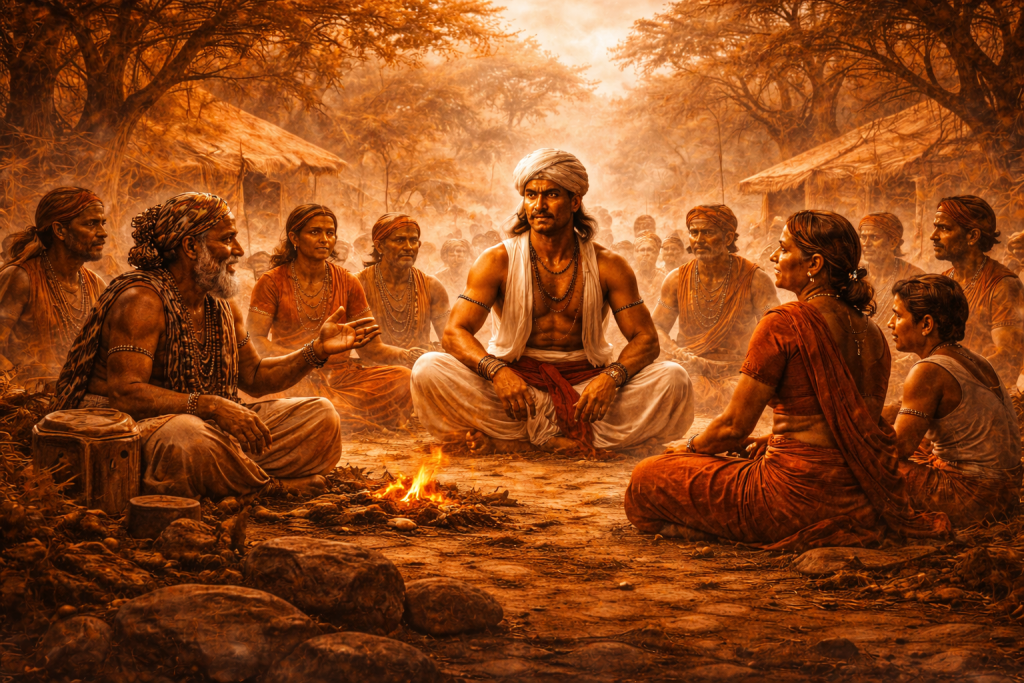
Leadership style within Bhil community
Bhima Nayak’s leadership within the Bhil community was deeply participatory and grounded in shared experience. Rather than ruling through authority or hierarchy, he led by example, living among his people and facing the same hardships they endured. His decisions were shaped by collective wisdom, guided by elders, and rooted in cultural traditions. This approach fostered trust, unity, and a strong sense of belonging within the community. By blending moral integrity with courage and strategic vision, Bhima Nayak inspired voluntary loyalty and collective action, transforming resistance into a shared responsibility rather than an imposed command.
Led through example rather than imposed authority
Deep trust built through shared struggle and humility
Inclusive decision-making with elders and community voices
Emphasis on unity, dignity, and cultural values
Inspired collective responsibility and voluntary participation
Moral Vision
Vision for Justice & Indigenous Rights

Justice for Oppressed
Bhima Nayak envisioned justice as protection from exploitation, where tribal communities could live without fear of forced labor, unfair laws, or colonial abuse.

Equality & Dignity
He believed all people deserved equal respect, rejecting hierarchies imposed by colonial rule and affirming the inherent dignity of indigenous lives and cultures.

Indigenous Rights
His vision emphasized safeguarding ancestral land, cultural traditions, and self-governance as fundamental rights essential to tribal survival and freedom.
Collective Identity
Tribal Unity & Cultural Preservation
Tribal unity was at the heart of Bhima Nayak’s vision and leadership. He understood that colonial domination thrived on division—fragmenting communities, weakening collective voices, and eroding shared identity. In response, Bhima Nayak worked tirelessly to strengthen bonds among tribal groups, encouraging solidarity rooted in shared history, struggle, and cultural belonging. He emphasized collective decision-making, mutual protection, and shared responsibility, transforming unity into a powerful tool of resistance. By fostering trust and cooperation among villages and clans, he ensured that resistance was not the burden of individuals but a collective movement. This unity restored confidence among tribal communities, reinforcing the belief that strength lay in togetherness rather than isolation. Through unity, Bhima Nayak helped convert cultural identity into a source of resilience, enabling tribes to stand firm against injustice and external domination.
Cultural preservation was inseparable from Bhima Nayak’s struggle for freedom. He recognized that the loss of language, rituals, traditions, and ancestral knowledge was as damaging as the loss of land. Colonial policies threatened indigenous ways of life by undermining customs, spiritual practices, and community structures. Bhima Nayak actively defended cultural traditions, viewing them as living expressions of dignity, wisdom, and continuity. He upheld oral histories, respected elders’ guidance, and protected rituals that reinforced social cohesion and moral values. By preserving culture, he ensured that resistance was not only political but deeply spiritual and social. His efforts safeguarded tribal identity for future generations, allowing culture to survive as a foundation of pride, resistance, and self-determination long after his lifetime.